
Shoelace Length: Define the End-to-End Reference
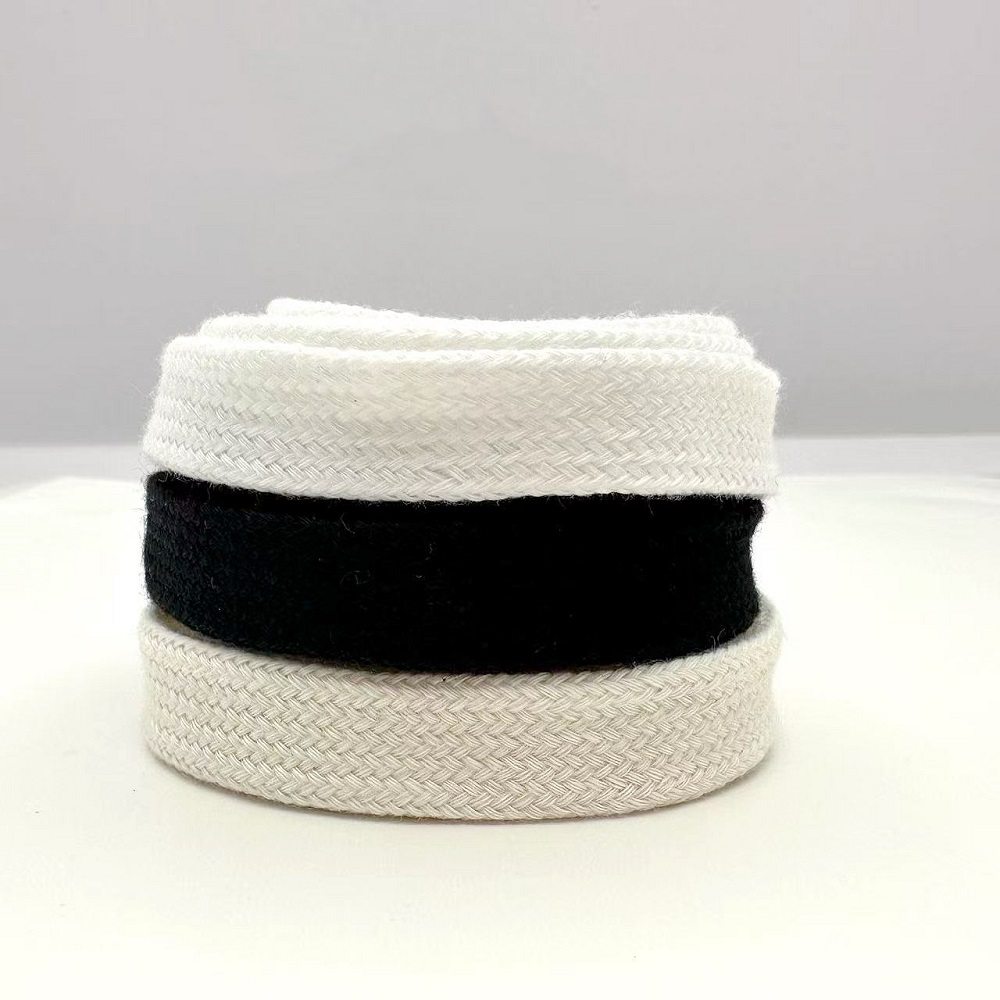
Separate cotton-style flat-lace catalogue reference. The arrangement identifies the product family, not a scale drawing or a measured finished length.
For a shoelace length enquiry, define the dimension of one finished lace and identify its two measurement endpoints. Ask whether any fitted tips are included, and record the condition used for measuring. Jiaying’s three flat-lace listings each give a 60CM–210CM size range, but the retained catalogue fields do not explain the measurement endpoints or the offered end construction.
For wholesale flat shoelaces, a precise length description helps purchasing compare equivalent proposals. A requested number in centimetres should remain attached to the exact product and its finished form. Keep this dimensional question separate from whether the supplier quotes by pair or metre; a commercial quantity unit does not define how an individual lace is measured.
Attach the length to the selected flat-lace listing
The flat double-layer braided crossover listing and the flat double-layer woven non-crossing listing both name Polyester and the 60CM–210CM range. Keep their different product references visible when requesting a particular length. A shared range does not make them one interchangeable construction.
The separate cotton-style flat shoelace listing gives Cotton Yarn in its material field and the same size range. Retain that supplier wording rather than adding an independent purity or performance claim. Ask the supplier to identify the actual offered version and its applicable length options for the current enquiry.
Name the two endpoints
Ask for a simple reference showing where the length begins and ends. For a tipped finished lace, ask whether the quoted dimension runs from one outer tip end to the other. If the supplier instead describes the textile body, request the boundary used at each end and keep that dimension separately labelled.
Do not assume that a product photograph establishes an aglet type, tip material or finished-end specification. State the end construction the buyer is requesting and ask what the supplier offers. The length description should match that offered construction, including whether the answer concerns a finished tipped item or another explicitly identified form.
Length field
Buyer identifies
Supplier response requested
Individual item
Exact lace product and offered form
Which finished item does the dimension describe?
Endpoint A and B
Marked ends on the reference
Are fitted tips included in the stated length?
Measurement condition
Requested dimensional comparison basis
What method and condition are used?
Requested length
Nominal dimension in stated units
What length and stated variation are offered?
Flat braided crossover-lace catalogue reference. Keep its nominal length and endpoint definition attached to the exact offered version.
Keep measurement condition consistent
Ask the supplier how the lace is presented for the reported dimension. Keep a laid-out reference distinguishable from a coiled display or a measurement taken under another stated condition. If a tensioned measurement is proposed, request its method instead of treating it as equivalent to an unexplained relaxed length.
Use the same endpoint and condition description when reviewing different samples. A photograph of several laces is useful for product identification, but it is not a measurement scale. Ask for the sample’s actual dimensional record, with the selected lace reference and the supplier’s measurement basis attached.
Request specific options within the catalogue range
The 60CM–210CM entry is a catalogue range, not a complete list of currently offered increments or stocked quantities. State the buyer’s requested individual length and ask the supplier to confirm the available proposal. If an alternative dimension is suggested, keep it beside the request rather than replacing the original number without explanation.
Name the exact flat-lace product for each requested length.
Keep finished-end and textile-body dimensions distinct where both are used.
Record the supplier’s offered dimension and any stated variation separately.
A lace length is not a universal footwear-fit claim. Keep any shoe-specific requirement as a separate buyer reference and ask the supplier to address the actual proposal. Do not assign a shoe size, eyelet layout or lacing result from the catalogue range alone.
Link the dimensional answer to the sample and offer
Ask the supplier to identify the physical sample represented by its answer. Retain the sample identifier, end construction, endpoint reference and measurement condition on one length record. If the end treatment or lace construction changes, request reconfirmation of the finished-length description for the revised version.
A concise message can ask: “Please confirm the individual finished-lace length for the selected product, show both measurement endpoints, and state whether fitted tips are included.” Send that reference through the Jiaying enquiry channel and retain the supplier’s reply with the quotation revision.
Separate non-crossing flat-lace catalogue reference. Similar colours do not establish identical length, end treatment or footwear compatibility.
FAQ
Does 60CM–210CM mean every length is currently available?
The range does not identify every offered increment or stock position. Request the exact length and ask for the current supplier proposal.
Are tips automatically included in a stated lace length?
Ask the supplier. The endpoints and offered end construction should be named on the dimensional record.
Does one length figure describe a pair?
Keep the individual-lace dimension explicit. Pair or metre quotation units belong in separate commercial fields.
What should accompany a length sample reply?
Keep the product, sample identifier, offered end construction, endpoints, units and measurement condition together.
Wholesale Flat ShoelacesFinished Lace LengthMeasurement Endpoints